

A customer booked three appointments in a row. They respond to your texts quickly. They even left a five-star review after the first visit.
Then one day, they stop showing up. No complaint. No negative review. They just … disappeared.
Sometimes this happens because businesses don’t “hear” what their customers are telling them. And that’s where a voice of customer analysis can help. VoC analysis gives you a repeatable way to collect what customers say and find the patterns. Then you make changes before customers’ frustrations turn into lost revenue.
For small businesses, VoC analysis doesn’t require a complicated survey platform or extensive research. Many of the customer insights you need already live in your call recordings, texts, reviews, and CRM.
We’ll walk you through the process of collecting the data you need for a voice of customer analysis and acting on what you learn.
What is Voice of Customer analysis?
Voice of customer analysis is about systematically collecting what customers say, in their own words. You look for patterns to understand their needs, frustrations, and expectations. Then you use that customer sentiment to improve your business.
But how’s that different from customer feedback?
Feedback is the raw data, like a review, a comment a customer makes on a call, or a survey response. VOC analysis is what you do with it.
You organize the feedback and draw conclusions about the customer’s perception of your business. This proactive approach is what lets you take action.
Many small businesses skip VoC because they’re busy, and this type of work sounds like more than they can handle. But consider this: one in five customers would leave a brand after a single bad experience. Your relationship with your customers might be more fragile than you think.
When your churn margin is thin, a VoC analysis could be the difference between keeping your customers and losing them to competitors.
Where can you find Voice of Customer data?
VoC data lives in more places than many small businesses realize. You’re probably already generating a lot of it. Here’s where you can find VoC data:
- Call recordings and transcripts. Every inbound call is a raw VoC data point. It captures what the customer asked, how they felt, and any objections that came up. A phone system like Quo can record and transcribe your calls, so you already have valuable customer intelligence to analyze.
- Text and message threads. Text conversations often contain candid customer reactions. You might find complaints, questions, and compliments that never make it into a formal survey. In Quo, these sit alongside your call data.
- Your CRM. Your CRM holds a record of every customer relationship. This data reveals your most valuable customer segments, which leads converted, and how often customers come back.
- Online reviews. Google, Yelp, and industry-specific platforms are a direct feed of high-stakes feedback. Customers who leave unprompted reviews are telling you a lot — positive or negative.
- Social media comments. Comments and direct messages reveal what customers ask about most often. Social listening on these platforms also shows you the actual language people use to describe you or your products and services.
- Support tickets and follow-up messages. Customers who reach out for help are telling you where they’re having problems. Issues that come up repeatedly — like billing, scheduling, or unanswered questions — are things you can fix.
- CSAT and NPS® surveys. You can use feedback tools to collect short, structured feedback at key moments. They capture how the customer feels after a job or a call and help you track customer satisfaction over time.
- Open-ended survey responses and feedback forms. When customers answer a “why” question in their own words, you learn what they’re thinking. Even one open-ended question at the end of a survey can help you spot patterns that you wouldn’t get from a 1–5 rating system.
Invest some time in thinking about where all your VOC of customer data lives. Once you know, your next step is building a process to gather and act on it.
How to run Voice of Customer analysis in 6 steps
You don’t need a large team or complex customer intelligence software to do a VoC analysis. Here’s a repeatable process for a small or growing service business.
We’ll use tools available with Quo’s business phone platform as an example throughout, so you can see how to collect data from the tools your business may be using.
1. Define one question you want to answer
The question you choose shapes everything: what you collect, where you look, and what you do with the results.
Not sure where to start? Here are a few common questions businesses try to answer.
- Why are customers not booking a second time?
- What’s making leads hesitate instead of moving forward?
- When are competitors coming up in conversations, and what are customers saying?
- Do customers compare you to competitors before they commit?
- Are customers mentioning your competitors when they leave?
- Where in the customer journey are you losing the most revenue?
Pick one question. You can expand to more later, but starting with a focused question keeps the process manageable. You can also take more targeted action when you have a specific problem you’re trying to solve.
2. Collect feedback across your key sources
For most service businesses, the phone is one of the primary sources of VoC and the most accessible starting point. But it also depends on the specific question you want to answer. For example:
- If you want to know why leads aren’t converting, search call recordings, call transcripts, and emails from lost deals.
- If you’re looking at why customers churn, check customer reviews, support tickets, and post-purchase messages.
- If you want to know which marketing channels are working, look at your lead sources in your CRM. You can see which channels bring in customers who book, which ones convert best, and where your marketing spend is going to waste.
- If you’re looking to attract more of your best customers, review call recordings of your most loyal customers. Look for how they found you and how they describe their needs. Then use that to find more people like them. On a Business Plan, Quo can automatically record and transcribe every customer call.

3. Organize what you’ve collected
You can’t do much with feedback if it lives in five different places. You’ve got call notes in one tool, reviews in a browser tab, and text messages buried in a thread. You have to bring it all together so you can connect the dots and spot patterns.
If you’re using Quo, all your calls, texts, voicemails, and customer history will already be in one place. Use the Calls view to see inbound and outbound calls, who contacted you, when, and how often.
If you want to zoom in on an interaction, just click on it. You’ll see the entire conversation, complete with messages, recordings, and internal team comments.

If you connect Quo to your CRM, call summaries will also sync automatically.

The next organizational step is tagging. Tags should identify different issues that come up, like pricing, scheduling, response time, or service quality. This lets you see what’s coming up most often, so you know where to focus first.
If you’re working with a small sample, you can do this using a simple spreadsheet.
💡You can make a copy of this free template to track your customer feedback: VOC Feedback Tracker
But manual tagging isn’t feasible when you’re working with a lot of data. On Quo’s Scale plan, AI call tags can automatically sort every call by topic, customer sentiment, and intent. Your calls are pre-organized so that you can move straight to the analysis.

4. Analyze for patterns, not one-offs
A single bad review doesn’t necessarily tell you much, since a customer might just be having a bad day. But if five customers raise the same concern in the same week, you have a pattern. Patterns are what you act on or fix.
A few things you should look for as you review your data:
- Frequency. Which topics keep coming up across calls, messages, and reviews? If four out of ten callers this month bring up your pricing structure, that’s worth looking into.
- Sentiment shifts. Is the tone of your customers’ feedback getting better or worse over time? A gradual change toward a frustrated tone — even before a negative review lands — is an early warning sign.
- Churn signals. Pay attention to the language customers use before they disappear. “Let me think about it,” unanswered follow-ups, and unresolved complaints commonly lead to customer churn.
Start with your call analytics
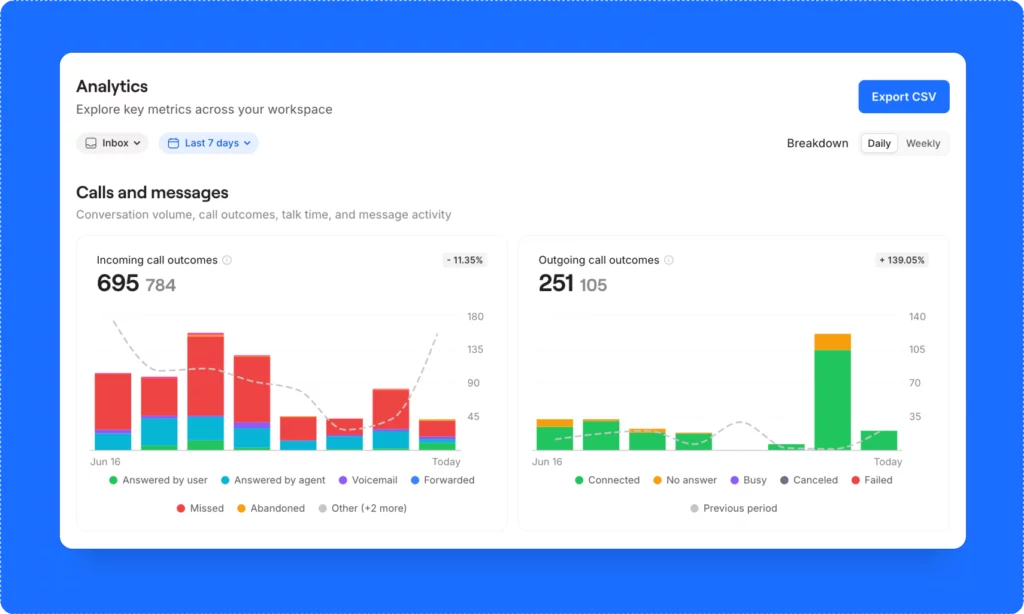
Quo Analytics can give you a baseline for your customer conversations. Pull up Quo Analytics and review your last 30 days. Look for patterns like:
- How many answered calls versus missed calls do you have?
- How many customers leave a voicemail versus hang up?
- How many text messages did you receive?
- How much time is spent on each call?
- What’s your speed to lead, or how fast do you respond to new inbound leads?
- How many follow-up outbound calls were placed?
Missed calls with no follow-through are one of the clearest signs of lost revenue. Inbound messages that never got a reply are another.
Use AI to analyze at scale
You might not have time to review 50 calls a week. But AI can. You can integrate Quo with Claude to analyze your transcripts and texts at scale.
With Claude call insights, you can ask targeted questions across hundreds of conversations.

Try prompts like:
- “What are the most common reasons leads didn’t move forward this month?”
- “Summarize the top themes from happy and unhappy customers in the last 30 days.”
- “Review inbound and outbound calls and texts from the past 60 days. What friction points come up right before a customer stops responding?”
💡 Pro tip: Explore more ways to uncover patterns with these Claude prompt examples.
5. Act on what you find and close the loop
The voice of customer analysis only benefits your business if you do something with it. But it doesn’t end there. You also have to close the loop by telling the customer you heard them and made a change.
Here’s how:
Turn every finding into an assignment. Each issue you spot needs a next step and an owner — someone internally who will act on the finding. For example:
- Customers keep asking the same questions about your rates? Rewrite how you present pricing.
- Multiple callers confused about their appointments? Revise your booking confirmation messages.
- Friday afternoon calls keep hitting voicemail? Make sure someone’s available during that time.
Reach back out to the customer. A simple follow-up — “We heard you and made this change” — builds trust. Even a one-line text shows them that their input led to a real change.
💡 Pro tip: With Quo’s Claude integration, you can send bulk messages to contacts who raised a specific concern. Try something like this: “Look at my Quo contacts on [business number] from the last 60 days and find everyone who expressed frustration about [pricing/scheduling/follow-up]. Draft a short text message letting them know we’ve made a change.”
With a complete feedback loop, your VoC process will improve your overall business. You can strengthen customer loyalty, increase your revenue, and reduce customer churn.
6. Make it repeatable
If you only run this process once, you’ll get a point-in-time snapshot, but not the full picture. Running it regularly gives you a system to work from. Aim to collect feedback continuously — such as weekly — and block a few hours each month to review what’s changed.
Scheduled Claude tasks can handle a lot of the heavy lifting for you. For example, you can use the AI to analyze calls in Quo on a weekly or monthly basis. Then instruct it to deliver results straight to you. For example, you can connect Claude with tools like Slack or Notion. Then, Claude can send a weekly digest of top sales objections or customer service complaints to a Slack channel.
You can also use Claude to track your weekly progress and goals. Feed it the question you defined in step one and have it measure changes in your Quo data over time. The data tells you whether the changes you made are having an impact.
💡 Dive deeper: See how our co-founder uses Quo’s Claude Connector for more ideas on automating customer intelligence.
What are the benefits of a VoC program?
If you’re still weighing the effort of running a VOC program for your business, here’s what it can do for you:
- You catch problems before they become negative reviews. Fifty-one percent of customers cancel without any prior warning. VoC helps you understand customer frustrations before they become public complaints or customer churn. You can figure out why deals fall through. Instead of guessing what happened with a lost lead, you can see the actual objections in your call data. VoC replaces gut feeling with data-driven decisions.
- You improve the customer experience without adding headcount. When your team knows what customers want and expect, they can provide a better customer experience. They can personalize interactions and handle difficult conversations effectively — without needing a bigger team.
- You invest in what actually matters. VoC reveals customer preferences that can shape your product development, marketing, and resource allocation. You can use it to prioritize your spending on what’s important to your customers and cut what isn’t delivering.
- You earn customer loyalty by following through. Customers are 2.4x more likely to stay with brands that resolve issues fast. When you close the loop proactively and your customers feel heard, they’re more likely to return and refer.
Common mistakes that could hurt your Voice of Customer analysis
Even businesses with good intentions for their VoC programs can be tripped up during their analysis. Watch out for the following.
- Only collecting feedback from surveys. Surveys only get feedback from the people who fill them out. Call transcripts, reviews, and text threads capture everyone else — including customers who’d never fill out a form.
- Treating a single complaint like a trend. One frustrated caller isn’t a pattern, and chasing outliers wastes your time and resources. Wait until you see a theme in at least 10% of a relevant sample before acting.
- Skipping the positive feedback. Happy customers tell you what to double down on. Which services generate the most referrals? Which reps do callers repeatedly ask for? If you only analyze complaints, you’re always playing defense.
- Not asking the right questions. “Were you satisfied?” doesn’t tell you much besides yes or no. Open-ended questions like “What could we have done differently?” give you language you can analyze.
- Reading feedback without checking your analytics. A wave of complaints about slow response times looks like a training problem. But if Quo Analytics shows call volume doubled that week, the real issue is capacity. VoC data without numbers behind it can send you in the wrong direction.
Start hearing what your customers are already telling you

Your customers share what they need and what frustrates them — every day, across every channel. VoC analysis lets you turn those signals into a system to improve your relationships and win business.
Once your process is running, dig deeper into your richest data source. If most of your feedback comes from calls, your call analytics can tell you how your team handles objections. They also show where follow-up is falling short.
Learn more about what sales and customer service teams can learn from call analytics.
If you want to start collecting call data, Quo’s seven-day free trial gives you call recordings, transcripts, analytics, and more to run your first VoC test.
FAQs
Most small businesses already have what they need. The core data for voice of customer analysis includes a business phone system like Quo with call recordings and transcripts. You can also use your CRM, customer reviews, direct feedback, and support tickets.
Text analytics applies natural language processing, or NLP, to identify themes and customer sentiment from unstructured data. It works on call transcripts, open-ended feedback, and customer reviews. Instead of reading every response, text analytics flags patterns across your data. Some tools use machine learning to improve accuracy over time.
Customer intelligence is the practice of analyzing customer behavior to guide business decisions. It relies on cross-channel customer data, including engagement, purchasing, and demographic data. You use it to find your most valuable customer segments, your customer lifetime value, or CLV, and where your churn risk is highest.
Start with the data you already have. Review call recordings, text threads, online reviews, and CRM data. Add one or two open-ended questions to any surveys you already run. If you’re not able to review all of your data, review a sample every week and track patterns in a spreadsheet. If you use Quo, your call and text data is already centralized and ready for analysis.
Net promoter score, or NPS, tells you whether a customer would recommend your business. A customer satisfaction score, or CSAT, captures how they feel right after a specific interaction. Customer effort score, or CES, measures how hard the customer had to work to resolve their issue. For most small service businesses, collecting a post-job CSAT and one quarterly NPS check is a solid starting point.
AI lets you analyze phone calls and text data at scale without a data team. Some tools can run sentiment analysis across hundreds of chatbot interactions or calls. You can connect Claude to Quo to dig deeper and ask questions about your data. AI call tags in Quo can handle identifying patterns automatically. Conversation analytics with AI makes it feasible for you to complete voice of the customer analysis, even with large volumes of data.
Pick one area to focus on or one question you’d like to answer. Collect feedback weekly. Block a few hours each month to review patterns, pick one or two changes, and assign ownership to people on your team. Review the results quarterly.


